

Over the past few years, I’ve noticed a pattern while working in compensation consulting Boston. According to recent workforce studies, companies with unresolved pay gaps are far more likely to face higher attrition and lower employee trust. I see this play out in real time with the businesses I work with.
I’m Laurence Ring, founder of Ring & Co Consulting, and I partner with growing teams who don’t realize these gaps exist until they start costing them talent and momentum. In this piece, I’ll walk you through what’s going wrong beneath the surface, and how I help clients fix it with clear, structured compensation systems.
What I See First: The Real Impact of Pay Gaps
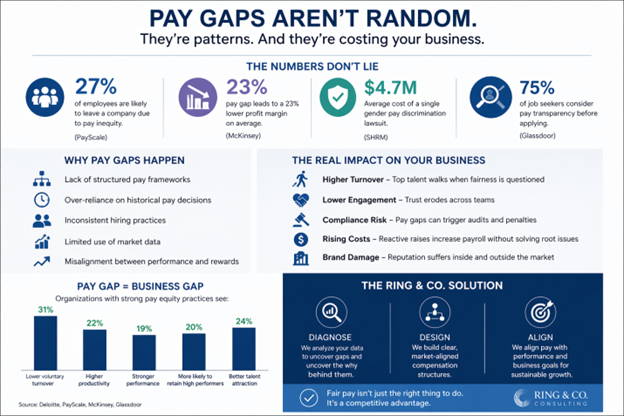
The Business Symptoms Clients Usually Bring to Me
Most clients don’t walk in saying they have a pay gap issue. They talk about people leaving without clear reasons. Some mention growing friction between teams around compensation. Others struggle to hire because candidates are not accepting offers.
What’s Happening Beneath the Surface
Once I start working in compensation consulting in Boston specific data with them, the pattern becomes clear to me. Pay gaps don’t stay hidden. They affect how employees feel and how teams perform.
- Retention Breakdown: Top performers exit when they sense pay decisions are unjust or inconsistent.
- Internal Trust Erosion: Employees start to doubt how leadership decides on pay.
- Compliance & Legal Exposure: Pay gaps can create risks that companies were not even aware of.
‘Pay Gap’ Patterns I Consistently Identify across Organizations
Lack of Structured Pay Frameworks
Many businesses operate without clear salary bands or defined roles. This leads to inconsistent pay decisions across teams.
Over-Reliance on Past Decisions
Old salary decisions stay in place for years. Without review, those gaps continue to grow.
Inconsistent Hiring Practices
Two candidates in similar roles receive different salary offers based on timing or negotiation.
Gender-Based Pay Inequality
One pattern I still see across organizations is unequal pay between men and women in similar roles. This doesn’t always come from intent. It often builds through hiring gaps, slower salary growth, or fewer promotion opportunities. Over time, this creates a visible gap that affects trust and can expose the business to risk.
Promotion and Performance Gaps
Rewards are not always aligned with contribution. Some employees move ahead faster without a clear reason.
My Perspective
I don’t see these as mistakes. I see them as “Missing Systems” that were never built in the first place.
How I Approach Pay Gap Problems at Ring & Co Consulting
Step 1: Diagnose the Gaps Clearly
I begin by reviewing your current compensation data in detail. I compare roles across teams, identify patterns, and benchmark against the market using compensation consulting with a focus on Boston insights.
Clients often give reviews that this is the first time they have a window into how pay is disbursed across their organization.
Clients gain: Complete transparency in where and why gaps exist.
Step 2: Build a Structured Compensation System
Once the gaps are clear, I design a system that brings consistency. This includes salary bands, job structures, and simple rules for making pay decisions.
The goal is not to add complexity. It is to remove confusion and give leaders a clear path forward.
Clients gain: Control over compensation decisions.
Step 3: Redeem Pay as Performance and Growth
I then connect compensation to both individual contribution and business goals. Pay decisions should reflect how the company is growing and what it values.
Through compensation consulting Boston work, this alignment helps businesses reward fairly while managing costs in a steady way.
Clients gain: A system that rewards fairly without overspending.
Building Effective Fair Pay Systems
What I Help Clients Implement
- Transparent and Consistent Structures: Employees understand how pay is set and what drives changes. This clarity reduces confusion across teams.
- Data-backed Decision: Every decision is supported by real numbers. This removes bias and improves consistency across the organization.
- Clear Communication Frameworks: Leaders can explain compensation decisions with confidence. This builds trust and reduces friction.
Over time, compensation consulting Boston becomes less about fixing issues and more about guiding smart decisions.
Creating a Long-Term Pay Equity Strategy
Why One-Time Fixes Don’t Work
Pay equity is not a single audit. As companies mature, they add new positions and hierarchies. Without ongoing attention, gaps return.
What I Focus on Instead
- Ongoing review of compensation data.
- Alignment with business growth.
- Systems that scale over time.
Outcome for Clients
- Reduced compliance risk.
- Stronger employer brand.
- Sustainable and fair compensation practices.
This is where compensation consulting Boston delivers long-term value, not short-term correction.
The Payoff
Pay gaps are neither arbitrary nor immutable. With the proper framework, however, they can be addressed and controlled going forward. At Ring & Co, I work closely with businesses to build systems that bring clarity and consistency to compensation. As compensation consulting Boston, I keep my attention on supporting you to make smarter decisions, minimize risk, and establish trust throughout your group. Fair pay is a powerful edge in the way you hire, retain and grow, only when done right.
1. Can pay gaps create legal or compliance risks?
Yes, pay gaps leave companies open to audits and lawsuits. If you can’t justify differences based on role or performance or experience, it can cause compliance issues.
2. Is fixing pay gaps a one-time activity?
No, wage gaps come back if you have no mechanism. The reality is that organizations require continuous audits, systems, and policies to keep pay equitable as well.
3. What type of businesses work with Ring & Co Consulting?
They primarily partner with SMBs that require transparent, data-informed compensation plans yet lack internal resources.
4. How does Ring & Co Consulting use data in compensation decisions?
They rely on market benchmarks, internal data, and role comparisons to inform decisions. As a result, it gets companies away from guesswork to scientific compensation strategies.
