

Most small businesses do not misprice roles because they do not care. Their job descriptions simply fail to match the work the market values. Clear job content changes that. Accurate levels and skills also make a difference. Together, they make market pricing faster, simpler, and more accurate. This guide uses plain English. It is for SMB owners, HR generalists, and hiring managers. Market pricing & salary decisions become more consistent with clear job descriptions.
The goal is simple. It helps businesses write job descriptions that match reliable market data. That includes curated salary surveys, official labour statistics, and trusted salary tools. It also helps them avoid relying on internal habits or job title preferences.
Why Job Descriptions Are the Linchpin of Market Pricing
Market data isn’t organized around your internal titles; it’s organized by job family, level, and typical responsibilities. If your JD is vague (“leads strategy”), inflated (“Director” without people or budget scope), or outdated (the role grew, the description didn’t), you’ll almost certainly match to the wrong benchmark—and then over‑ or under‑pay.
Think of a high‑quality JD as a translation layer between your internal role and an external market match. Clear translation will lead to tighter matches. Compensation practitioners and survey providers are under constant stress. Content and scope drive matching. Titles alone are a poor guide. Clean job content also reduces pay inequities by aligning like‑for‑like work to like‑for‑like ranges. Market pricing & salary decisions improve when every role has clear scope.
The Most Common Smb JD Mistakes (and Why They Distort Pay)
1) Title Inflation
Labeling a senior individual contributor “Director” or “VP.” The market reads the title as higher scope and impact, pulling in a pricier peer set. Result: you pay elevated ranges for smaller‑scope roles and create internal compression.
2) Franken‑jobs (Grab‑bag Roles)
Combining two or three distinct functions—e.g., HR + Office Manager + Recruiting, or Product + Data + QA—into one “super” role. The market rarely has a single benchmark for that blend, so your pricing signal becomes noisy and inconsistent.
3) Vague Responsibilities
Bullets like “drives strategic initiatives” don’t reveal the decision rights, complexity, budget, team size, systems, or typical project scale. Without these facts, job matching becomes guesswork. That weakens market pricing & salary decisions across the business.
4) Stale Descriptions
The org scales, adds new platforms, or hands the role a book of business—but the JD never changes. You keep benchmarking yesterday’s job and paying too low (or occasionally too high).
Consequences: chronic over‑pay for “big title, small scope” roles; under‑pay for complex hybrids; and internal inequities when similar jobs were written and matched differently.
What Compensation Data Actually Cares About
Surveys, government data, and curated tools classify jobs and levels consistently. They rely on a common set of leveling factors. These factors help compare similar roles across organisations. Such as:
- Job Family/ Discipline: Software Engineering vs. IT Support vs. Sales vs. HR.
- Scope: Individual contributor → lead → manager → director (and beyond).
- Impact: Local team vs. function‑wide vs. company‑wide decisions.
- Complexity & Autonomy: Problem types, ambiguity, independence.
- People Leadership: headcount, layers, and whether results come through others.
- Scale & Stakes: budgets, revenue influence, customer volumes, or system complexity.
- Qualifications & Skills: required certifications, regulatory requirements, and critical technical/hard skills (years of experience can be a proxy, but skill‑based signals are rising).
Practical Takeaway: If your JD explicitly states these factors, you’ll map to the right benchmark with far more reliability—and your ranges will be defensible and easier to explain. Strong job content supports market pricing & salary decisions with confidence.
How to Write Market‑aligned Job Descriptions (Practical Playbook)
1) Start With a Job Purpose (2 Sentences)
State why the role exists and how it drives business value.
Example: “This role ensures on‑time, on‑budget client implementations for our SMB customers. Success means faster go‑lives, higher NPS, and lower post‑launch support volume.”
2) Separate Must‑haves From Nice‑to‑haves
Must‑haves anchor level; nice‑to‑haves guide selection. This avoids pricing to a “unicorn” that doesn’t match any real market job. This also supports accurate market pricing & salary decisions.
3) Describe Scope Concretely
- Decision Rights: What can the role decide vs. recommend?
- Scale: Typical project budgets, customer volume, technical environment size.
- People: Direct reports (how many, which levels) or cross‑functional leadership.
- Financials: Revenue/cost influence where applicable.
4) Use neutral, Market‑standard Language
Replace internal jargon with terms the market recognizes. Don’t hide core functions behind vendor names; e.g., “CRM administration” > “HubSpot guru.”
5) Organize Responsibilities by Themes
Group 4 to 7 points under each heading:
- Operations
- Customers/ Stakeholders
- People/ Leadership
- Financial/ Systems
This mirrors how survey jobs present content.
6) Include an Evolution Note and Review Cadence
State that duties will evolve with growth. The one responsible will review things annually. Or, upon major scope change. All this to keep pricing aligned with reality. It also keeps market pricing & salary decisions aligned with current responsibilities.
Consultant Tip: Write the JD as if you’re explaining the role to an external survey analyst. What do they actually do? At what scale? And, with what decision rights?
Leveling: The Glue Between JDs and Pay Ranges
You don’t need enterprise complexity. A simple 3–4 level structure per job family brings clarity:
- Coordinator/ Associate (Entry): Executes defined tasks. Limited decision rights.
- Specialist/ Intermediate (Mid): Owns workstreams. Need to solve moderately complex problems. Will require advising peers.
- Senior/Lead: Handles complex and ambiguous problems. Acts like a mentor. Exercises broader influence and will lead projects.
- Manager/Director: Achieves outcomes through others. Owns budgets and sets standards. Ultimately shapes function strategy.
Tie each level to a distinct market range. Market pricing & salary benchmarking outcomes become easier to justify at every level. As visible responsibility increases with level, pay differences become explainable and predictable, improving fairness perceptions and offer acceptance.
How to use JDs in the market pricing workflow
Step 1: Draft/ Refresh the JD
Purge title inflation and clarify scope. Also, remove any form of jargon.
Step 2: Identify Job Family & Level
Let scope determine level—not the title.
Step 3: Match to External Benchmarks
Use curated surveys as anchors; cross‑check with official labor data; use vetted tools as directional context. This creates a stronger foundation for market pricing & salary decisions. Select the closest content match with the correct geo/industry/size cuts.
Step 4: Cross‑check for Mismatch
If the external job assumes bigger scope (e.g., larger budget or people leadership) than your JD, either adjust the match or rewrite the JD to reflect actual work.
Step 5: Document the Match & Rationale
Record survey job codes, cuts used, chosen level, and why. This creates a clear record for market pricing & salary decisions. It is also invaluable when ranges are questioned, reviewed, or audited.
Pricing Combo Roles:
If a role truly blends functions, identify the dominant anchor first. Then assign a secondary anchor for the remaining responsibilities. For example, use 70% Office Ops and 30% HR Admin. Price each, then blend the range proportionally. Document the weighting and revisit if the mix changes.
When to Revisit:
- Major scope growth (team added, budget ownership, regulatory load)
- Business scale shifts (more markets/customers/systems)
- Annual market refresh or mid‑year checks for hot roles
Practical Before/ After Examples
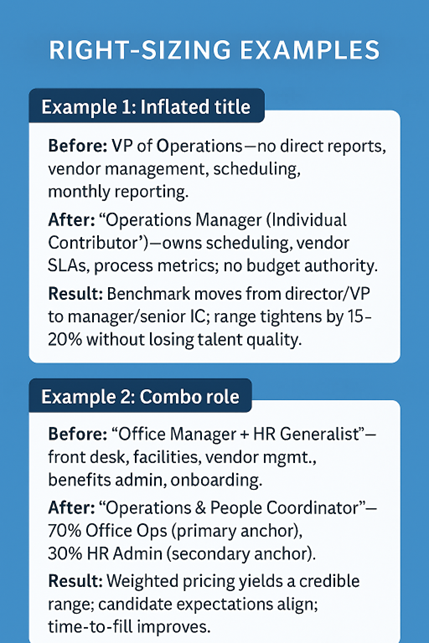
A Simple, Reusable JD Template (Market‑aligned)
Job Title
Use market‑standard phrasing; avoid prestige inflation.
Job Family & Level
Example: Operations • Senior Individual Contributor
Job Purpose (2 Sentences)
- Why does the role exist?
- How it delivers value?
Key Responsibilities in 4 or 7 points
Operations: …
Customers/Stakeholders: …
People/Leadership: (if any) …
Financial/Systems: …
Scope & Impact (facts > adjectives)
- Decision rights: …
- Scale: budgets, volumes, territories, environment size …
- People: # of directs/indirects (if any), cross‑functional leadership …
Required Skills & Experience (Must‑Haves)
Anchor Level: Critical certifications, core skills, domain knowledge. These factors also support accurate market pricing & salary decisions.
Nice‑to‑Haves
Helpful extras that don’t change the level.
Notes
Duties evolve as the business grows. We review job content and market pricing annually or upon major scope change.
Get the Role Right on Paper, and the Market Data Will Finally Make Sense
If your JDs are fuzzy and not updated, your market pricing will be, too. Every role needs clear job content. Levels should reflect real responsibilities. Scope and skills must stay well defined. Salary benchmarking then becomes fair, competitive, and repeatable. Market pricing & salary strategies stay aligned as roles continue to evolve. Start with 3–5 critical roles. Rewrite the JDs using this guide and match them carefully. Document your rationale and schedule a review cadence. You’ll get tighter ranges and fewer compensation debates. It becomes easier to explain pay decisions. Discuss things confidently to candidates and employees.