

Let’s have a look first:
- If employees feel they’re paid fairly, they’re more likely to stay → lower hiring costs
- The right incentives push people to perform better → higher productivity
- Competitive pay helps attract top talent → stronger business outcomes
- Clear, structured pay reduces internal conflicts → better workplace culture
For businesses, these are not just HR wins, they directly influence financial outcomes. A well-defined compensation strategy connects how people are paid with how the business performs.
Companies are now seeing returns of 150% to 300% within the first year because compensation is tied to measurable results. The conversation is shifting from “what are we paying?” to “what are we gaining?” and that’s where real impact begins to show.
Compensation Strategy as a Revenue Lever, Not a Cost
It helps in reframing compensation as an investment not cost. How you pay people is going to impact your retention, their effort in the workplace and your speed of hiring. These are not soft metrics, they influence revenue, margins and operational efficiency.
When compensation is structured well, businesses experience growth On the other hand, reactive pay decisions often lead to inefficiencies that quietly eat into profits. Companies that approach compensation strategy strategically tend to outperform those that simply adjust salaries based on market pressure.
Where the ROI Actually Comes From
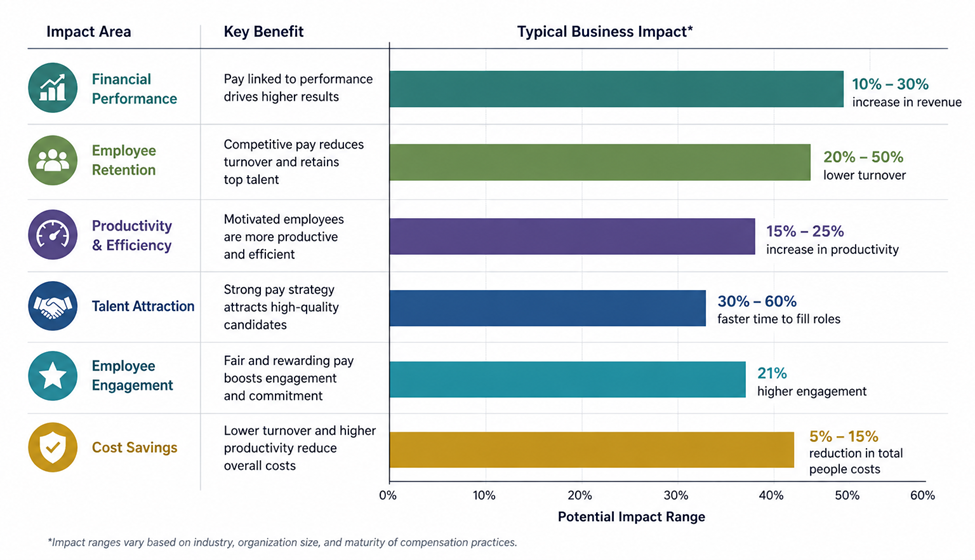
1. Reduced Turnover Costs
It may cost 50-150% of the annual salary to replace an employee. A smart compensation strategy enhances retention by making employees feel appreciated and adequately compensated. That in itself can save big bucks over the long run.
2. Rapid Hiring with Better Offers
You’ll find that when wages are right in line with market compensation, candidates will snap up offers. This decreases time-to-hire, which frequently equates to lost output or revenue.
3. Eliminating Pay Inefficiencies
Without a proper payout structure, companies tend to overpay new hires, or make abrupt salary adjustments to keep workers on board. A smart compensation strategy sidesteps these reactive costs by relying on objective standards.
4. Productivity Gains
Automated compensation frameworks minimize grunt HR work. Rather than wrangle spreadsheets, teams can spend their time on strategic decisions. Numerous organizations see as much as 40% time savings in compensation management activities.
The Hidden Cost of Getting Compensation Wrong
The real problem is not always visible upfront. Some issues build over time, caused by poor compensation practice.
- Unplanned salary hikes disrupt budgets because there is no structured approach guiding decisions.
- High performers walk out the door first when they’re not appreciated, taking key know-how with them.
- Compliance risks are also on the rise, particularly as pay transparency expectations increase.
In many cases, doing nothing costs more than investing in a proper compensation strategy.
What Makes a Compensation Strategy Deliver High ROI
● Market Benchmarking
Businesses ensure their pay process is competitive and accurate by using real time and role specific data. This is more helpful than outdated surveys.
● Pay Transparency and Equity
If there’s no clear communication around pay decisions, then at least transparency to build trust. They’re less likely to ask if something is fair when they understand the rationale behind pay.
● Performance-Linked Pay
Rewarding outcomes instead of tenure motivates employees to focus on results that matter to the business.
● Total Rewards Approach
Salary alone is not enough. Bonuses, benefits and flexibility all contribute to perceived value, often without increasing fixed costs significantly.
Together, these elements turn compensation strategy into a predictable and scalable system that supports business growth.
Ring & Co Consulting: Making Compensation Work for the Business
This is often the point where businesses realize something, having a compensation strategy is one thing, but making it work is another. That’s where Ring & Co Consulting comes into the picture.
Rather than reinventing the wheel, we concentrate on doing the fundamentals better. We focus on whom you pay, who decides and where the money may be leaking without your noticing. Then we bring structure into it, so compensation stops feeling reactive and starts making sense.
What sets us apart is our pragmatic methodology. It’s not about grand theories or elegant frameworks. It’s about assisting companies tie pay choices to actual results such as improved retention, streamlined hiring, and reduced unexpected expenses.
At the end of the day, Ring & Co helps turn compensation into something that supports growth, instead of something you keep fixing every few months.
ROI Recap
A smart compensation strategy is no longer simply about containing payroll, it now drives business outcomes. It increases retention, fortifies recruiting and adds transparency to expenses. These advantages compound over time, generating a more stable and effective workforce.
Companies that view compensation as a strategic lever get a leg up that others find hard to equal. And again, those that act early get the biggest benefit, because the effect compounds over time. For the long-term, a strategic compensation strategy turns into a top lever for enduring growth and advantage.
Compensation Strategy Q&A:
1. Can compensation strategy help in employee retention?
Indeed, transparent and equitable compensation fosters loyalty and contentment. This encourages employees to stay longer in the company and perform better. In this way recruitment expenses can be controlled and preserve team cohesion.
2. How frequently should a Compensation Strategy be revisited?
Ideally companies must review their strategy yearly or at significant business transitions to keep it in step with market trends, business growth, and changing workforce expectations.
3. Does Ring & Co Consulting help with pay transparency and compliance?
Yes, they guide companies in building transparent and compliant compensation frameworks that reduce risks while improving employee trust and internal fairness.
4. What makes Ring & Co Consulting different from generic HR solutions?
They focus on practical, data-driven strategies that link compensation directly to business results, not abstract HR frameworks that guarantee measurable impact, transparency for decision-makers, and sustainable organizational success.